By Robert Crosby | VP of Institutional Sales | Finaeon, Inc.
By Tomé Martinez | Economist | Finaeon, Inc.
When the 2026 World Cup group stage draw placed Cabo Verde in Group H alongside Spain, Saudi Arabia and Uruguay the reaction in most football circles was the same. Who are they and where exactly is Cabo Verde?
The answer is as compelling as the question. A chain of ten volcanic islands sitting roughly 570 kilometers off the coast of Senegal in the Atlantic Ocean, Cabo Verde is one of the smallest nations by population ever to qualify for a World Cup. With around 500,000 people it is smaller than most cities hosting the tournament this summer.
But small has never meant simple. And the data behind this island nation tells a story that stretches back much further than most people would expect.
A History That Starts Before Independence
Cabo Verde’s story as a traceable economic entity begins not in 1975 when it gained independence from Portugal but considerably earlier. The islands were uninhabited when Portuguese explorers arrived in the 15th century and they quickly became a significant hub in Atlantic trade routes including the transatlantic slave trade. By the late 1800s the archipelago was generating economic data as a Portuguese colonial territory and that is precisely where Finaeon’s data series begins.
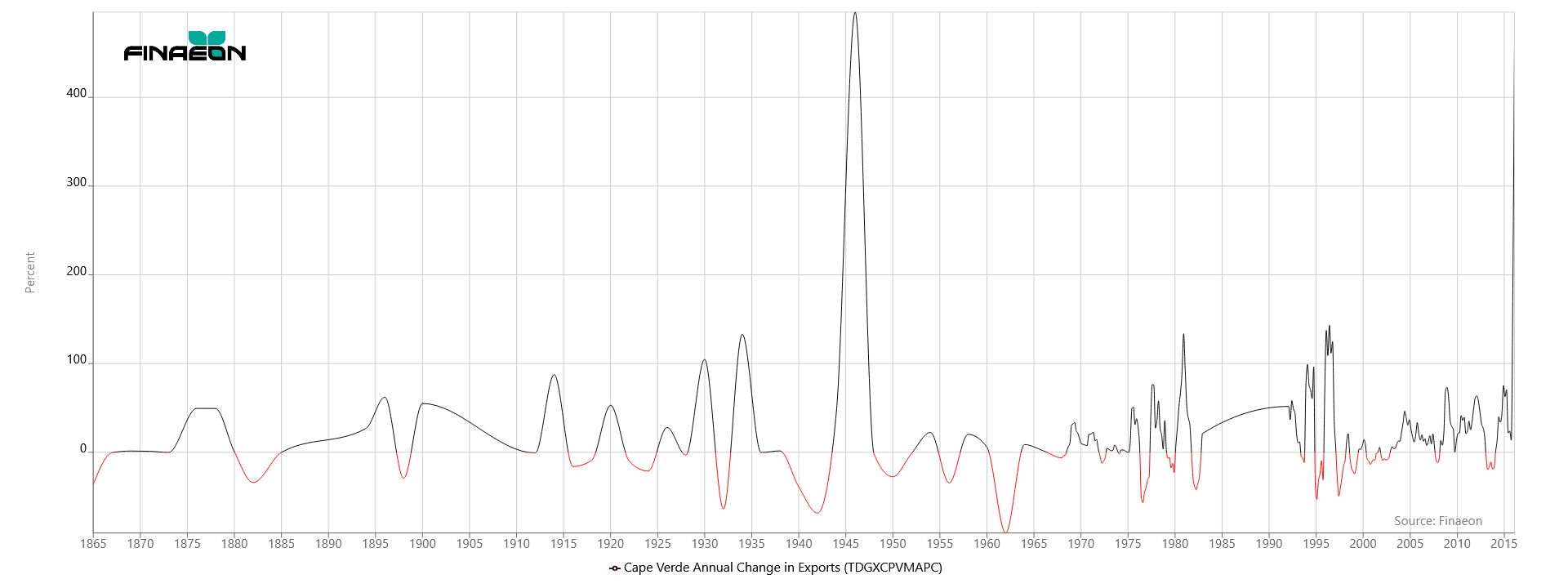
Cabo Verde Annual Change in Exports (1865–present) | Source: Finaeon
The first chart tells that full story. From 1865 to the present the annual change in Cabo Verde’s exports has moved through colonial administration, world wars, independence and globalization. Each spike and contraction in that line corresponds to something real happening in the world and on those islands.
The most dramatic feature of the long-view chart is the extraordinary spike approaching 500 percent around 1945. This is not a data error. It reflects the dramatic disruption and partial recovery of Atlantic trade routes during and immediately after World War II. Islands sitting at the crossroads of Atlantic shipping lanes felt the war’s economic impact acutely and the postwar rebound was equally sharp. That single data point is only visible because the series runs long enough to provide the context around it.
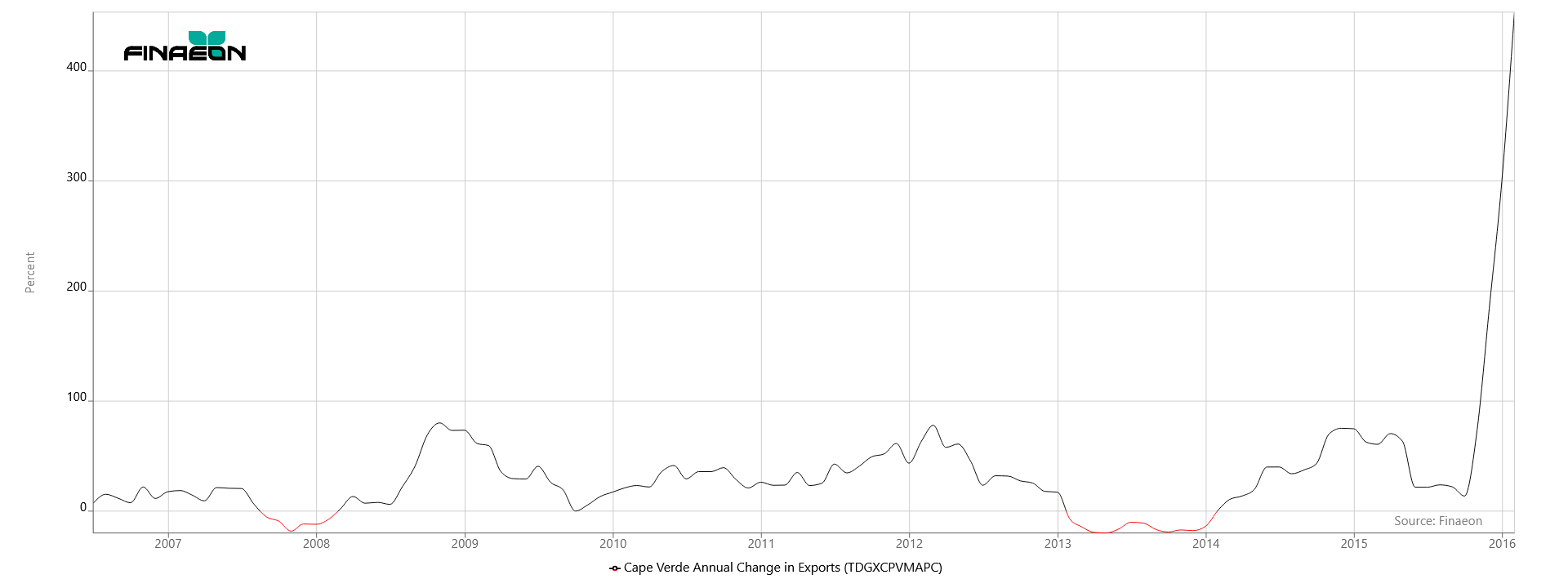
Cabo Verde Annual Change in Exports (20-year view) | Source: Finaeon
What the Economy Actually Looks Like
Modern Cabo Verde is an economy built almost entirely on tourism. The islands draw visitors from Europe in particular with their year-round warm climate, dramatic volcanic landscapes and Portuguese-African cultural blend. But tourism’s dominance also means vulnerability. When global travel stops as it did in 2020 the economy contracts sharply with very little buffer.
Most of what the islands consume is imported. Food, fuel and manufactured goods arrive from the mainland and from trading partners across Europe and the Americas. The export base is narrow and the rare Fogo coffee grown on the volcanic hillsides of the island of Fogo represents one of the few genuinely distinctive agricultural exports the archipelago produces. Grown at altitude in volcanic soil it commands premium prices in specialty markets but the volumes are small.
This economic profile creates a pattern visible in both charts: modest and relatively stable export growth punctuated by sharp reactions to external shocks. The 2008 global financial crisis appears clearly in the 20-year chart as a contraction around 2008 and 2009 followed by a strong rebound as European tourism recovered. The collapse around 2013 and 2014 reflects a period of broader economic stress on the islands. And the extraordinary spike toward the right edge of the 20-year chart approaching 400 percent reflects the post-pandemic recovery in travel and trade as Cabo Verde’s tourism-dependent export economy bounced sharply off a near-zero base.
The World Cup as an Economic Signal
Cabo Verde’s appearance at the 2026 World Cup is not just a football story. For an island economy that depends on international visibility to drive tourism the exposure that comes with a World Cup debut is genuinely significant.
Consider the data pattern from other small nations that have made unexpected tournament runs. When a country of 500,000 appears on screens watched by billions of people the effect on tourism interest is measurable and it tends to compound over several years. Travel searches spike. Booking inquiries follow. The economic return on footballing success for a nation this size is disproportionately large precisely because the baseline visibility is so low to begin with.
Whether Cabo Verde can advance beyond the group stage against Spain, Saudi Arabia and Uruguay is a question the football analysts will debate. What the economic data suggests is that simply being there already represents an inflection point.
What 150 Years of Data Reveals
The Finaeon data series on Cabo Verde is unusual in its depth. Very few data providers track economic indicators for small island territories back through colonial administration into the 19th century. But that depth is exactly what makes the data valuable.
Looking at 150 years of export change you see a small open economy that has repeatedly absorbed external shocks and recovered. Colonial trade disruptions, world wars, droughts that periodically devastated the islands through the 20th century and the volatility of global tourism markets all appear in the data as scars and recoveries. The series doesn’t tell a story of linear growth. It tells a story of resilience.
That pattern matters for anyone trying to understand where Cabo Verde’s economy goes next. A World Cup debut in front of a global audience. A post-pandemic tourism recovery already visible in the recent data. A government that has pursued economic reform and international partnerships aggressively since the 1990s. The signals are there for those willing to look at the full series rather than just the most recent data point.
At Finaeon that is always where we start. Because the story that begins in 1865 is still being written and the next chapter is playing out on football pitches this summer.
ABOUT THE AUTHORS
Robert Crosby
Finaeon, Inc. | Friendly sales guy who genuinely loves data. Always happy to connect and talk through what’s possible.
Tomé Martinez
Finaeon, Inc. | Economist
Finaeon specializes in deep historical financial and economic data because understanding where things are going requires knowing exactly where they’ve been. Learn more at finaeon.com.